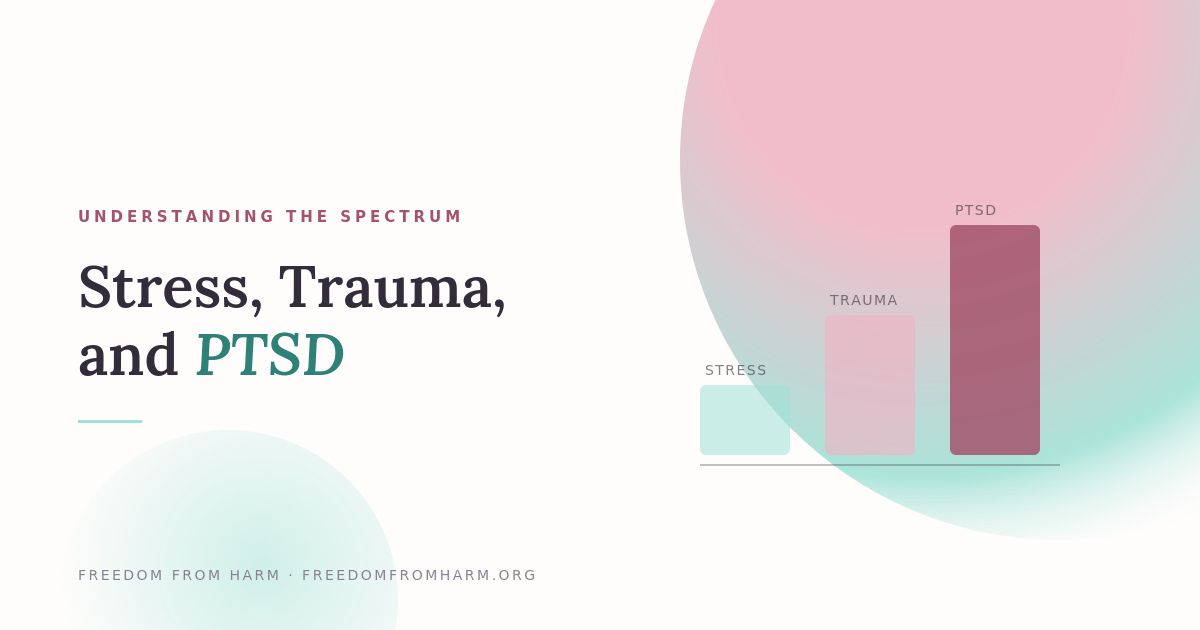
Stress, trauma, and PTSD often get used as if they're the same thing at different volumes. They're related, but they're not interchangeable — and knowing the difference can help you figure out what kind of support you actually need.
Stress is a normal, even useful, response to a demanding situation — a work deadline, a difficult conversation, a full schedule. It resolves once the situation resolves, or once you've had time to recover from it. Stress becomes a bigger problem when it's chronic and unrelenting, but it's still a fundamentally different experience from trauma.
Trauma occurs when an event — or a pattern of events — overwhelms your nervous system's capacity to process it in real time. Unlike ordinary stress, trauma doesn't simply resolve when the situation ends. It can leave the nervous system on alert long after the danger has passed, even if you don't meet full clinical criteria for PTSD.
PTSD is a specific clinical diagnosis: persistent intrusive memories, avoidance of reminders, negative shifts in mood or beliefs, and heightened arousal, lasting more than a month and significantly disrupting daily functioning. Not everyone who experiences trauma develops PTSD — but for those who do, the symptoms tend to persist without treatment rather than fade on their own.
Ordinary stress often responds well to rest, boundaries, and time. Trauma and PTSD usually need more than that — they need processing, often with professional support, because the nervous system has learned a threat response that won't simply relax on its own. If what you're feeling hasn't eased with rest and time, that's a sign it may be trauma rather than stress, and worth taking seriously as such.
Originally published on Terri's Medium blog.
Take the two-minute self-check — private, and nothing is saved.
Take the Quiz